This post was published by a guest. The views expressed are those of the author and do not necessarily reflect the views of alien-covenant.com.

Photo by Marek Pavlík on Unsplash
There’s horror, and then there’s the kind that makes you question your place in the universe. Lovecraftian horror doesn’t rely on cheap jump scares or masked killers lurking in hallways.
Instead, it taps into something far more unsettling: the idea that humanity is insignificant in a vast, indifferent cosmos.
But what exactly makes a film Lovecraftian, and why do certain movies capture this eerie essence so effectively?
The Core of Lovecraftian Horror
At its heart, Lovecraftian horror stems from the works of H. P. Lovecraft, whose stories revolved around cosmic dread, forbidden knowledge, and ancient entities beyond human comprehension. Films inspired by his themes often share several defining traits.
First, there’s the concept of cosmic insignificance. Characters are not heroes destined to save the day. Instead, they are small, fragile beings confronted with forces they cannot understand, let alone defeat. The universe in these films is not evil in a traditional sense. It simply doesn’t care.
The second is the fear of the unknown. Lovecraftian films rarely show everything outright. The horror lies in what remains unseen or only partially understood. This ambiguity leaves audiences unsettled, forcing them to imagine horrors far worse than anything explicitly depicted.
Finally, there’s forbidden knowledge. Characters who dig too deep into ancient texts, alien signals, or unexplained phenomena often pay the price. The more they learn, the closer they come to madness or destruction.
Hallmarks of Lovecraftian Cinema
Several films have successfully translated these themes into visual storytelling, even if they aren’t direct adaptations of Lovecraft’s work.
Take The Thing by John Carpenter. Set in an isolated Antarctic research station, the film captures paranoia and existential dread as an alien entity mimics its victims. The horror isn’t just the creature itself but the realization that identity and trust can dissolve completely.
Similarly, Annihilation explores the psychological and physical breakdown of characters encountering an incomprehensible phenomenon. The “Shimmer” defies logic, biology, and reality itself, embodying the kind of unknowable force central to Lovecraftian lore.
Then there’s In the Mouth of Madness, another Carpenter film that leans heavily into meta-horror. It blurs the line between fiction and reality, suggesting that ancient entities can reshape existence through belief and storytelling.
Cosmic Entities and Ancient Forces
A defining feature of Lovecraftian films is the presence of entities that exist beyond human understanding. These beings are often ancient, god-like, and indifferent to humanity’s survival.
In The Lighthouse, the horror is less about a visible monster and more about psychological decay and possible encounters with something mythic and unknowable. The ambiguity keeps viewers questioning what is real and what is imagined.
Likewise, Color Out of Space directly adapts Lovecraft’s work, presenting an alien force that mutates everything it touches. Its influence is incomprehensible, and its motives remain entirely alien.
The Alien Franchise as Lovecraftian Horror
At first glance, the Alien franchise might seem like straightforward sci-fi horror. But look closer, and it fits remarkably well within the Lovecraftian framework.
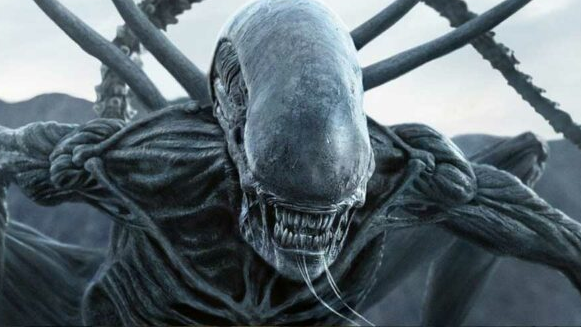
The original film introduces the Xenomorph, a creature that is both biological and disturbingly alien. Its life cycle, design, and behavior are unsettling because they defy familiar categories.
But it’s not just a monster; it’s an organism shaped by forces humans barely grasp.
More importantly, the franchise expands into cosmic territory with the introduction of the Engineers, an ancient species tied to humanity’s origins.
Films like Prometheus suggest that humanity itself may be the byproduct of indifferent cosmic experimentation. That idea, that our existence is accidental and meaningless in a grander scheme, is pure Lovecraft.
Even the tone of isolation, whether aboard the Nostromo or on distant planets, reinforces the sense of being alone in a vast, uncaring universe.
Why Lovecraftian Horror Endures
Lovecraftian films resonate because they challenge comforting narratives. There are no clear victories, no tidy resolutions. Instead, they leave audiences with lingering unease and existential questions.
In a world where people often seek control and certainty, this genre reminds us that some things cannot be understood or conquered. It’s a humbling, if not slightly terrifying, perspective.
Even in unexpected places, echoes of this cosmic unpredictability appear. For instance, the thrill of uncertainty in online experiences like PHBingo can mirror, in a far lighter sense, the tension of facing the unknown.
The difference, thankfully, is that one involves entertainment, while the other involves existential dread and, possibly, losing your sanity.
Final Thoughts
Lovecraftian horror isn’t about monsters jumping out of the shadows. It’s about the shadows themselves, and what might exist beyond them.
Through themes of cosmic insignificance, forbidden knowledge, and incomprehensible entities, these films create a unique kind of fear that lingers long after the credits roll.
Whether it’s the paranoia of The Thing, the surreal dread of Annihilation, or the cosmic implications of Alien, Lovecraftian cinema continues to unsettle audiences by reminding them of a simple, uncomfortable truth.
That the universe is far bigger, stranger, and less concerned with us than we’d like to believe.